Showing posts with label Chloe Ellefson. Show all posts

Friday, October 19, 2018

A Strong Sense of Place: A Guest Post from Kathleen Ernst


We welcome Kathleen Ernst, author of the new Lace Maker's Secret, the ninth book in the Chloe Ellefson Mystery Series, to Midnight Ink's blog today! Here she talks about why the setting is such an important element of a book.

Authors sometimes debate which is most important: character or plot. Character comes first, in my opinion, but the discussion itself often ignores an element that should rank right up there in the top tier: setting.

As a reader, I gravitate toward books that provide me with a strong sense of place, books that transport me somewhere new with complete authenticity. I try to do the same with the Chloe Ellefson mysteries.

Chloe is a curator at a large outdoor ethnic museum called Old World Wisconsin, a real site where I once worked as a curator. When writing the first book in the series, writer friends urged me to create a fictional historic site. I couldn't imagine doing so. I knew, and wanted to share with readers, real and special historic places.

As the series has progressed, books have featured other museums and historic sites in the Midwest. The ninth book in the series, The Lace Maker's Secret, is set in northeastern Wisconsin, home to the largest rural community of Belgian-Americans in the nation. Chloe has been hired to develop a furnishings plan for a Belgian Farm being restored at Heritage Hill Historical Park in Green Bay.

The Lace Maker's Secret includes a strand of historical fiction braided with Chloe's story. It introduces Seraphine, who immigrated to Wisconsin in the 1850s with her new husband. The Belgians came looking to farm, and were granted acreage in forested land instead. This is how I described their arrival:
"Jean-Paul," Seraphine hissed."This can't—" She stumbled, fell to one knee, clambered back to her feet. "This can't be right." The uncertainty in her husband's eyes did nothing to stay her growing unease.

…They were following their guide through a forest, deeper and deeper, away from the bay of Green Bay which had, for a time, glimmered through the trees. There was no trail, just several inches of slushy snow to hide roots and rocks. They shoved through thickets and skidded down ravines and clambered over windfalls. The trees were so tall and thick that midday was gloomy as twilight. Every strange bird call startled Seraphine. Every cracking branch made her jump. The cold pressed into her bones, numbed her toes. She carried a bulky sack over one shoulder. The skillet dangling from one mittened hand slipped from her grasp over and over. …How could the guide possibly know where he was going? They'd been walking for hours. There were no landmarks. The endless forest had swallowed them.


The Belgian immigrants faced hunger, epidemics, and a devastating forest fire. I couldn't hope to convey Seraphine's story without imagining the place where she landed.

While researching the mystery I spent a lot of time in Green Bay talking with site staff and volunteers, digging through the employee library, visiting local historical societies. But one of the most meaningful things I do when developing a new book is less academic: I settle in.

There is something powerful about walking the ground where 19th-century immigrants once walked. There is something powerful about gaining insight into their environment, and how it impacted their lives. There is something powerful about simply hunkering down with a notebook in hand to record the specific sensory details that will help bring a description to life.

I hope readers will enjoy being conveyed to another time and place as much as I do.

***
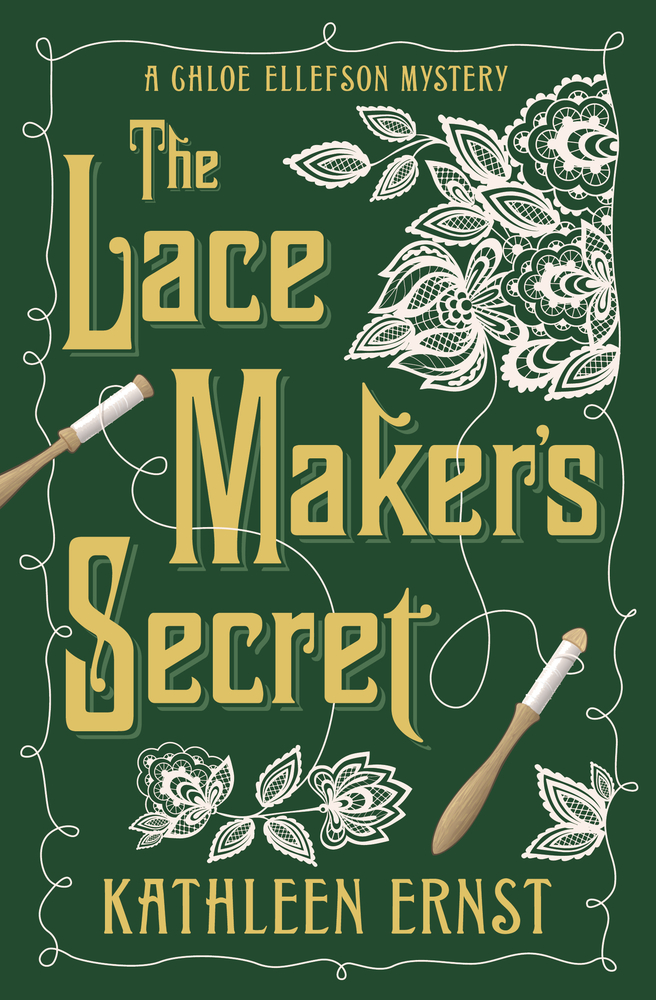
The Lace Maker's Secret Greed, Uncertainty, and Death Get Tangled in the Mystery of a Rare Piece of Belgian Lace

Curator Chloe Ellefson needs distraction from the unsettling family secret she's just learned. It doesn't help that her boyfriend, Roelke McKenna, has been troubled for weeks and won't say why. Chloe hopes a consulting job at Green Bay's Heritage Hill Historical Park, where an old Belgian-American farmhouse is being restored, will be a relaxing escape. Instead she discovers a body in a century-old bake oven.

Chloe's research suggests that a rare and valuable piece of lace made its way to nearby Door County, Wisconsin, with the earliest Belgian settlers. More importantly, someone is desperate to find it. Inspired by a courageous Belgian woman who survived cholera, famine, and the Great Fire, Chloe must untangle clues to reveal secrets old and new...before the killer strikes again.


Praise:

"In this heartfelt tale of labor and love, Ernst produces one of her most winning combinations of historical evocation and clever mystery."
Kirkus Reviews


Kathleen Ernst is an award-winning and bestselling author, educator, and social historian. She has published over thirty novels and two nonfiction books. Her books for young readers include the Caroline Abbott series for American Girl. Honors for her children's mysteries include Edgar and Agatha Award nominations. Kathleen worked as an Interpreter and Curator of Interpretation and Collections at Old World Wisconsin, and her time at the historic site served as inspiration for the Chloe Ellefson mysteries. The Heirloom Murders won the Anne Powers Fiction Book Award from the Council for Wisconsin Writers, and The Light Keeper's Legacy won the Lovey Award for Best Traditional Mystery from Love Is Murder. Ernst served as project director/scriptwriter for several instructional television series, one of which earned her an Emmy Award. For more information, visit her online at KathleenErnst.com.

Tuesday, December 3, 2013

Curator, Cop

I often describe the protagonist of my Chloe Ellefson mysteries as a reluctant sleuth. Museum curator Chloe is much more interested in folklore and artifacts than in solving crimes. She gets pulled into investigations when her specialized knowledge is needed.


Otherwise she leaves police work to local cop Roelke McKenna. In the newest installment, Heritage of Darkness, Chloe and Roelke collaborate to solve a murder that takes place at Vesterheim Norwegian-American Museum.

Chloe and Roelke are becoming more than friends. A romantic relationship has presented challenges, however. The two have very little in common.

So I was intrigued when Milwaukee radio host (and discerning reader) Mitch Teich asked me about the professional attributes Chloe and Roelke share.

Mitch is quite right. Every museum curator is a bit of a sleuth.

This wooden goat head reveals a lot about traditions that play a role in Heritage of Darkness.  (Image courtesy Vesterheim Norwegian-American Museum)
Obviously the historical research needed to create programs at historic sites and museums involves investigation. Curators must be able to find and interpret clues in written records, oral tradition, artifacts, visual images, folklore, etc. in order to plan events and activities.

Old World Wisconsin's "The Spirit of Christmas Past" 
Chloe is a curator of collections. In a museum setting, artifacts are valued for what they can reveal about the people who made, owned, or used them.

Artifacts like this ale bowl always leave me wondering about the original owners. (Vesterheim Norwegian-American Museum)
When an antique ale bowl disappears in the first book of the series, Old World Murder, Chloe's primary concern isn't the antique's monetary value.

In order to understand who might desperately want the bowl, she considers all the other reasons it might be important.  She must explore what's known about the piece in order to discover what has not yet been revealed.


So I guess Chloe and Roelke have more in common than it may initially appear.  That's good, because I have a lot more crimes in mind for these two investigators to solve.


For more information about the Chloe Ellefson mysteries, visit www.kathleenernst.com


Wednesday, November 6, 2013

Wreaking Havoc

The plot of my new Chloe Ellefson mystery, Heritage of Darkness, reflects the fundamental challenge I face each time I begin a new book in the series.  First, I pick a town and museum or historic site that I love to serve as setting.

Then, I start making (fictional) trouble.


Heritage of Darkness is set in Decorah, Iowa. The plot sees Chloe, her mother, and boyfriend/cop Roelke McKenna visiting Vesterheim Norwegian-American Museum for folk art classes in December. The week gets off to a bad start when Chloe peeks inside an artifact trunk and finds a woman who was attacked and left for dead.

This is the trunk, which is on display in the Norwegian House exhibit at Vesterheim.
"I'll never be able to look at that trunk the same way," one of the curatorial staff told me after reading an advance draft of Heritage of Darkness.

Another key scene takes place in one of the buildings preserved in the museum's Open-Air Division. A volunteer who leads tours there had much the same reaction.

The Valdres House (in red) provided just what I needed.
Fortunately, both the volunteer and the curator thought that Heritage of Darkness was great fun.

Since all the books in the Chloe Ellefson series deal with the past, I work hard to learn as much as I can about not only the events that drive the actual plot, but the history of the museum or historic site being featured. I have a filter in my brain that automatically picks up on anything that I might be able to put to use in a mystery.

When I began writing the series, several writer-friends advised that I use fictional historic sites. I did consider that, but in the end couldn't do it.  My plots are inspired by real events, and I love having the opportunity to share museums I admire with readers.


Many readers seem to love that too. Some have the fun of reading a mystery set in a place they know well. Others are intrigued by what they read, and follow up by visiting the site.

So far, everyone involved with the host museum for each book has embraced the Chloe mysteries with enthusiasm. The books are set thirty years in the past, which provides some distance. Also, since I only write about places that I truly love, I think that in the end, that honest affection shines through more brightly than the passing details of a murder mystery plot.

Last week I had the pleasure of officially launching Heritage of Darkness at Vesterheim Norwegian-American Museum.

Here I am with Steve Johnson, Vesterheim's Director.
It was a wonderful experience, in part due to the partnership that emerged as I worked on Heritage of Darkness. The staff has been phenomenally supportive. The museum gave us permission to include photos from their collection in the book, for example. In return, I'll do my best to introduce the museum to a new audience.

It's exactly what I hoped would happen when I began conceptualizing a mystery series featuring an historic sites curator.

I'm grateful for all the museum staff and local readers who have forgiven me for wreaking fictional havoc at the sites featured so far in the Chloe series. I hope to keep writing Chloe Ellefson mysteries, and building partnerships like this, for a long time.

Display at the Vesterheim Museum Store.

To learn more, please visit http://www.kathleenernst.com/chloe_ellefson.php


Wednesday, October 9, 2013

The Zone

I attended a signing by William Kent Krueger, Ellen Hart, and Libby Fischer Hellman last week at the fabulous new indie bookstore in Madison, WI.


It's always fun to attend events featuring other mystery authors. One of the things I enjoy is hearing questions from people in the audience.  It's helpful to learn what mystery readers want to know.

One man noted that athletes sometimes described being "in the zone," when everything disappears except the play. He wondered if authors every experienced something similar.

Responses ranged from "hardly ever" to "all the time, and it's wonderful." I won't attribute comments to specific authors because I'm paraphrasing from memory, but it was clear that people had very different experiences.

I spent years in the living history world as both an interpreter at an historic site and a reenactor at a variety of parks and battlefields. Reenactors sometimes speak of "the bubble," a moment when everything seems so real that they forget the present. Such bubbles are rare, and only last for seconds, but they are powerful. They are one of the reasons some reenactors go to extensive lengths to recreate a period environment as closely as possible.

Cavalry reenactors at Harpers Ferry National Historical Park.
I've had a few such moments over the years. When I worked as an historical interpreter, I spent my days in period clothing, going about the everyday tasks and chores of a 19th-century farm woman. While I loved sharing stories with visitors, I must admit that my favorite times were cold or rainy days when few guests ventured onto the site.

That's me, working at Old World Wisconsin, 1982.
These days I venture into the bubble most often in my imagination. Like most writers, I have days when I never lose awareness that I'm sitting in front of a computer, trying to figure out what to say next. Deadlines are always looming, so I don't have the luxury of waiting for inspiration to carry me away.

More often, though, I do enter what has been called a flow state. Wikipedia defines it this way:

Flow is the mental state of operation in which a person performing an activity is fully immersed in a feeling of energized focus, full involvement, and enjoyment in the process of the activity. In essence, flow is characterized by complete absorption in what one does.

For me, Flow means disappearing into the scene I'm imagining. Although I often write in coffeeshops, I don't hear what's going on around me, or see who is coming or going at the next table. When I go on writing retreats, and hole up somewhere quiet, it's even better. Hours can pass before I emerge.

When I get going, even my cat knows to settle down.
My first four Chloe Ellefson Historic Sites mysteries were set in places I knew very well, which made it easier to disappear into my imagination. I'm celebrating the release of Heritage of Darkness this month. It's set in Decorah, Iowa---a place I love---and I hope that readers will be able to disappear into the pages in much the same way.


I'm also working hard on the fifth book. I chose to set this book in places I don't know as well, and at the beginning I wondered if I'd be able to find a good rhythm. Happily, once I got going, the writing began to flow.

As I thought about the gentleman's question, I realized that for me, pushing myself to write even when the words aren't flowing well actually leads me back to that place where they do flow. It's a paradox of sorts, but my advice is this:  don't stop because you're not in The Zone.  Keep working, keep going, and The Zone will find you.


Wednesday, September 11, 2013

Christmas All Year Long


My fourth Chloe Ellefson mystery, Heritage of Darkness, is soon hitting the bookshelves. Chloe Ellefson, my curator-protagonist, has traveled to Vesterheim Norwegian-American Museum in Iowa.


The book takes place during the first week of December, 1982. Chloe is asked to interview several elderly people about their Christmas traditions. Those traditions shape the plot. The book’s climactic scenes takes place against the backdrop of the museum’s annual Norwegian Christmas Weekend.


Several friends have wondered about the Christmas theme. Have I limited my audience? Will people want to read the book in July? Will Jewish readers be put-off?  Etc., etc.

I can’t help wondering why I haven’t ever gotten the similar questions in reverse. The first book in the series, Old World Murder, takes place in June; The Heirloom Murderstakes place in July; The Light Keeper’s Legacy takes place in September. No one’s ever asked if I’m worried that readers won’t want to read those books in winter.  No one’s suggested that the series is only of interest to Christian readers because Chloe was raised in the Lutheran church.


Perhaps it’s the specific holiday that prompts the question.  Are people in the mood for Christmas reading while sunning on a beach?  Will people who don’t observe Christmas be interested?

Obviously, I hope so.  What attracted me to this time and place is the wealth of heritage and traditions swirling around the holiday observances.

Photo courtesy Vesterheim Norwegian-American Museum.
Chloe discovers that some of the customs popular in Norwegian-American communities have roots that stretch far into the pagan past, when evil spirits roamed the skies during the darkest, coldest days of the year. Any humble peasant who dared venture forth was in danger, and people developed unique traditions as they tried to ward away evil.

Darkness, evil, fear…all pretty good stuff for a mystery writer!  I had great fun weaving some of the folklore into the plot.


So, what do you think? Are you careful to read books only “in season?” Do you mind reading books that touch on specific holidays? I’d love to hear your thoughts!


Want to learn more? You'll find lots of resources on the Heritage of Darkness page of my website.

Wednesday, May 22, 2013

Speed Dating For Writers

by Kathleen Ernst

I recently attended Malice Domestic, an annual celebration of the traditional mystery. Participating authors were invited to enter a drawing to earn a place on the roster for Malice-Go-Round. "It's like speed dating for authors," explained Barb Goffman, who organized the event.


I've been involved with Malice for years, but this is the first year my name came out of the hat. I teamed up with my writer-pal Molly MacRae. Convention attendees (i.e. readers) settled down at twenty banquet tables to be enlightened.

Teams of authors moved from table to table. Each author had two minutes to introduce readers to our newest titles, and thirty seconds to move to the next table.

That's me introducing readers to the latest Chloe mystery,
The Light Keeper's Legacy.  (Greg Puhl photo)
The next ninety minutes passed very quickly. At the end I was exhausted. Would I do it again? Heck, yes! I was very glad for the opportunity to make a personal, if brief, connection to so many avid mystery fans.

If you're considering participating in this or a similar event, here are a few observations:

If you have the opportunity, work with a friend. Molly and I quickly developed a rhythm that perfectly fit the allotted time. It also helped, I think, that our books have some common elements.

Me and Molly at Love Is Murder in Chicago Last Febraury,
 where we were each honored with LOVEY Awards.
(I participated in a similar event once where I was paired with a new author at each table. The organizer explained that the rotation was set up that way so no individual was "stuck" with a time-hog for the entire session. A fair point, but it made it impossible to ever settle into a routine.)

I asked several readers afterwards what worked best for them. Their suggestions were simple:  Be friendly. Make eye contact. Share why this book is important to you instead of simply summarizing the plot. Don't over-hype.

Since I'd just received my ARC of the next Chloe Ellefson mystery,
 I couldn't resist showing that too.  And my latest kids' mystery is on the table! (Greg Puhl photo)
The feedback on giveaways was mixed. A few authors walked in with baskets full of little gifties, which immediately instilled in me an inferiority complex. Like most, I passed out bookmarks. I appreciated it when people who weren't interested in my work simply passed them back to me before I left the table. Most of the readers I spoke with said they took everything home to sort through later.

One table was left empty so each author team would get a four-minute rest break part-way through. I assumed "part-way" meant "half-way," and so steered Molly to Table 1. What I didn't notice was that the rest table was the *last* table, so Molly and I didn't get a break at all. Not my best move ever, but hey, somebody had to take Table 1. And Molly's still speaking to me, so all ended OK.

Finally, I have to give a shout-out to Barb Goffman and her team. Malice-Go-Round worked like the proverbial well-oiled machine, thanks to their organization. (And Barb does this on top of organizing panels, too.)

Here are all the participating authors. (Greg Puhl photo)

I've already signed up for Malice 2014, and I'll toss my name into the Go-Round lottery again.   Hope to see you there!


(Until then, you can always visit me at www.kathleenernst.com - I have some great book giveaways going on!)


Wednesday, March 27, 2013

Historical Fiction?

by Kathleen Ernst

Recently, a reader asked if my Chloe Ellefson Historic Sites Mysteries are historical fiction.


The first three books in the series are set in 1982.  I was in my early twenties then, so for much of the cultural context, I simply tap my own memories.  For me, and for some of my readers, the '80s were the good old days.


On the other hand, some of my readers weren't born until well after 1982. I occasionally get emails from people wondering about details like coiled telephone cords.


So, are the Chloe books historical fiction?  Depends on who you ask.  Some writers' organizations set an arbitrary date---if a book is set before 1960, for example, it is indeed "historical."

The Historical Novel Society takes a different approach.  That group considers any novel historical if it takes place before the author was born.  That means an author approaches the setting through research, not memory.  I like that definition because it focuses on process.  It does set a sliding scale, though.  A book set in 1990 might be classified as historical fiction, while a book set in 1943 might not.

When I'm writing for kids, the whole notion of historical fiction presents a different challenge.  My latest children's mystery is set during the War of 1812.  It's hard for an eight-year-old to get a handle on "two hundred years ago."


I sometimes get letters from kids who seem to think I lived through the War of 1812.


I cherish the curiosity evident in that letter.  How cool that the young letter-writer finished a book and felt compelled to write to the author!  The literal meaning of "two centuries ago" doesn't matter.

Bottom line:  I don't really care how my books are classified.  I hope they tell good stories and touch readers' hearts.  If they foster an interest in history... that's frosting on the proverbial cake.

Speaking of cake, I'm celebrating the publication of my 25th book--Traitor in the Shipyard--with 25 weeks of book giveaways.  Interested?  You can find all the details on my own blog, or on my Facebook Author Page.  Readers make everything possible, and I'm grateful!

Wednesday, September 5, 2012

Strong Women

by Kathleen Ernst

I’m celebrating a launch today—but it’s not the latest Chloe Ellefson book.

As I’ve mentioned on Inkspot before, I write for both children and adults.  In early 2009, American Girl invited me to create a character set during the War of 1812.  I said yes, and began the long process of researching and writing a series aimed at girls age eight and up.

Now, at long last, my six books about Caroline Abbott are hitting the shelves.
I’ve written two Caroline books and a Chloe Ellefson Historic Sites mystery every year for the past three years.  The deadlines have been challenging, to put it mildly.  But I wouldn’t have given up either project.  As I send Caroline into the world, and anticipate sending the third Chloe mystery into the world very soon, I’ve been thinking about that.

What do all these books have in common?  Strong females.

Caroline is nine years old as the series begins.  When the United States declares war on Great Britain, she and her family are plunged immediately into the thick of it.  Her father is captured by the British, leaving Caroline, her mother, and her grandmother to keep the family’s home and shipbuilding business going.

Creating these three characters was very satisfying.  Grandmother, who was widowed during the Revolutionary War, is frail of body but strong of spirit. 

Caroline 019
Mama immediately takes charge of the family shipyard and begins negotiating contracts with the US Navy.  Each in their own way, both of these women provide wonderful role models for Caroline.

In rural middle-class families, it was not uncommon for young children of the period to be given what might seem to modern readers extraordinary responsibilities.  This gave me room to give Caroline a lot to handle as the series unfolds.  She sometimes makes mistakes but does the best she can, with her mother and grandmother as examples of what women are capable of.  And Caroline figures out that even a young girl can make a positive difference in difficult times.

How does she compare to Chloe Ellefson?  At the beginning of her series, Chloe is recovering from clinical depression.  The challenges she faces in solving the mystery in Old World Murder help her recover her inner strength.  While a few readers have characterized Chloe as weak because she struggled with depression, I think that her past makes her a much more complex and fully realized woman; and I hope that her ability to leave that past behind as the series unfolds makes her inner strength that much more satisfying.
Lightkeepers cover reduced
The mysteries Chloe explores often reveal some aspect of strong women from history.  She discovers women who may have had few options, but nonetheless did their best to stand up to difficult times, to find or make beauty of their world, to help their families and community.  The Light Keeper’s Legacy, which is coming soon, includes an historical timeline braided with Chloe’s investigation.  Several strong women emerge from the past—but more about that another time.

I love writing about strong women--nine years old or ninety; real or imagined.  I hope that readers of all ages enjoy spending time with them, too.

To learn more, visit http://kathleenernst.com.

The gorgeous illustrations from the Caroline Abbott books were created by Robert Papp.

Tuesday, April 24, 2012

Kids and Mysteries

by Kathleen Ernst

Getting mail from kids is surely one of the great perks of writing for young readers. I recently got a lovely stack of letters from third graders. Their teacher had read one of my children’s mysteries, Danger at the Zoo, aloud in class.  Afterwards they spent some time on my website, and learned more about me and my work.

Whenever I get a batch of letters like this, I can predict some of the questions they contain.   But there are always surprises, too.  I think this is the first time a child asked me my beverage of choice.

letter 2
Other letters are revealing in other ways.  This student thinks I shouldn’t be quite so wordy.

letter 4
Several kids were interested in my Chloe Ellefson mysteries—my "murder books."
letter 1
letter 5
letter 6
letter 3  
In that last one the child was at least asking if their parents might like them.  Still, the interest and questions reveal a quirk to consider in promoting my work.  Many kids are intrigued by the notion of murder.  And if they enjoyed one of my kids’ mysteries, they get even more interested when they discover I’ve written books that include murder.

In general, I believe kids will self-select books that are appropriate for them, and that’s as it should be.  Since these particular kids are in third grade, I explained that while their parents might enjoy the Chloe Ellefson mysteries, I was sure they’d have more fun exploring my other books written for young readers.

End of the story?  Not quite.

A short story I wrote was recently published online in Women Writing the West’s Laura Journal.  It’s darker than I usually write, and although I don’t go into details, the theme is mature (sexual abuse in the 19th century).  It earned Honorable Mention status in a competition, and now that it’s published, I’d like to steer readers in that direction.

But I have young children regularly visiting my website, and following me on my own blog and on Facebook.  Knowing that, I’m just not comfortable posting the link to that particular story in those places.  (As far as I know, we don’t have too many eight-year-olds following Inkspot.)

On the flip side, having young fans has been a boost for the Chloe Ellefson mysteries.  I’ve heard from a number of teens who read my children’s books when they were younger, and now have become avid Chloe fans.  That is, of course, extremely cool.

So…what do you think about kids reading mysteries written for adults?  Should kids be allowed to sample whatever they wish, or should certain books be labeled out-of-bounds?

Tuesday, April 3, 2012

Killing the Good Guys

by Kathleen Ernst

Murder scene 10355ow0tj1tld8 FreeDigitalPhotos

I recently joined a book group to discuss my Chloe Ellefson mysteries, and one of the members had a question I hadn’t fielded before. In the first book, Old World Murder, a very nice character is killed about mid-way through. “How can you create such an appealing character and then kill him off?” she asked.

We discussed the choice of victims in murder mysteries, and the conversation moved on. However, I’ve been thinking more about it. In the second Chloe mystery, The Heirloom Murders, two nice people are killed. In The Light Keeper’s Legacy, which comes out in October, another nice person takes the hit.

I didn’t plan to kill a sympathetic character per se. In each case, the victim suited the needs of the story. Creating a sympathetic victim can up the emotional stakes too, making it even more important to find the killer and bring him/her to justice.

I’m well into the opening stages of writing a fourth Chloe mystery. In this one, by chance, I took the opposite approach. The victim is a generally unpleasant woman. Once the crime is committed lots of people can go on the suspect list because she did so many not-nice things to so many people.

Obviously, there is no right or wrong approach. I do think, though, that I’ll try to keep balance in mind as the series progresses.

How about you? Do you prefer your mysteries to include unlikeable murder victims? Do you appreciate the extra heart-tug when a favorite character dies? Or does it not matter? I’d love to hear your thoughts!

http: kathleenernst.com

image courtesy Simon Howden, http://www.freedigitalphotos.net/images/view_photog.php?photogid=404

Thursday, November 10, 2011

With A Cast Of Thousands

by Kathleen Ernst

Well, no, not really thousands. But my current WIP, Beyond Death’s Door, does have a large cast. And although my protagonist Chloe is the primary character, three others have point-of-view scenes. Most of the book takes place in 1982, but it does include an historical timeline as well.

iStock_laptop WTF

Given that, I’ve been thinking about including a “Cast of Characters” at the front of the book.

A recent discussion on a mystery writers’ Listserv touched on that idea. I didn’t catch it all, but at least some posters lamented how the inclusion of a cast list seems to have fallen from favor. I’m paraphrasing here, but one person noted that the characters weren’t the most important people in readers’ lives, as they may at times seem to the author. She voted in favor of inclusion.

Great! I thought. I will include a character list in Beyond Death’s Door.

Then I happened across a comment from Chris Roerden in her book Don’t Murder Your Mystery: 24 Fiction-Writing Techniques To Save Your Manuscript From Turning Up D.O.A. It’s a good book, and I often flip through it as I near the end of a draft. While encouraging writers to introduce characters gradually, she writes: “One novel I began to read named twenty characters in the first chapter. If I hadn’t been looking forward to reading that author, I would have viewed the family tree on the flyleaf as the omen it was.”

Obviously a too-big cast, poorly introduced, is not the hallmark of a great book. But her comment about the family tree on the flyleaf as “omen” gave me pause.

So…what do you think? Do you see a cast list as a helpful tool, or an omen of bad things to come?

Friday, October 21, 2011

Signing Books

by Kathleen Ernst

In the (many) years between first finished book and first published book, I dreamed of that most writerly of tasks: sitting at a table and signing copies. The notion that someone might actually want me to was almost beyond comprehension.

Well, books got published and sometimes people do want me to sign them. What I didn’t know, way back then, was that I’d be so bad at it.

Malice Domestic 7

Not meeting readers—I adore that part. Not giving programs about my books—I’m pretty good at that too. I even have nice handwriting and a couple of lovely pens.

The problem I have is trying to chat while signing. It’s a reader’s moment to ask a question or tell me something important, and I like that bit of one-on-one. But I’m not good at multi-tasking. When someone is talking with me I have trouble remembering my own name, much less theirs.

Once a family stopped me in the parking lot as I was leaving a signing. I’d written a lovely inscription in the book they’d just purchased, but in the midst of our conversation, I’d somehow forgotten to actually sign my name. Twice I’ve had to purchase my own books because I botched the inscription.

I run into more trouble when someone approaches the table and asks, “Remember me?” I have a horrible memory, and I’m afraid I don’t always remember a reader I met three years ago. Even worse, my Chloe Ellefson books are (so far) set at a place where I worked 20-30 years ago. Sometimes former colleagues come to my programs, and every now and then I can’t for the life of me find their name in my mental vault. (In my own feeble defense, I did supervise 60-80 people a year, for a decade.)

THM-LaunchPartyLine-OWW09Oct2011

I try to get around such lapses by keeping a pad handy. Whenever someone hands me a book, I ask them to spell their name, and I write it down. “I always like to check spelling,” I say cheerfully. (Me writing it, as opposed to them scribbling it on a Post-it or something, helps solidify the letters in my brain for a moment.) Everyone once in a while even that fails, as with the man I’d met before who gave me a disappointed look and said “B-o-b.”

I always write the date on the top of the pad, as well. I tend to forget.

If someone buys multiple titles, I try to write a little something different in each one. I’m not so good at that either, especially if they hand me five or six books.

KAE signing Waupaca

The hardest signings of all are with kids. I know this is a special occasion. I want them to leave with a happy memory and a legible inscription, but sometimes I do better than others. Kids like to see what I’m writing and watch me sign my name. They crowd around, sometimes jostling the table and sending the pen in a direction I did not intend.

All this is not to complain. Far from it! I’ve had a dream come true, and I try to savor every moment. But if you happen to ask me to sign a book, please don’t mind if I need you to repeat your name, or if I write the wrong date by mistake. The story itself will be much more polished, I promise.

Thursday, September 15, 2011

Documenting the Crimes

“Chloe found the first body right there,” I said, pointing.

My husband Scott said, “Perhaps you should keep your voice down.” Then he balanced precariously on the shifting beach cobbles and started shooting. Digital images, not bullets.

Rock Island lighthouse beach

I’ve mentioned before that Book 3 in the Chloe Ellefson series will take place on Rock Island, WI, in Lake Michigan. It’s a state park. Much of the action will take place at Pottawatomie Lighthouse; I’ve had the good fortune to serve as a live-in docent there several times, and know it well.

lighthouse NW view

But other scenes take place at other locations on the island, such as the magnificent boathouse.

Rock Island boathouse

Since my mysteries are rooted in long-ago events, I do a lot of historical research. And since I write about real and public places, I need to be careful about getting not just the historical details but the geography right.

Rock Island south point

Book 3 (tentatively titled Beyond Death’s Door) takes place the first week in September, and Scott and I spent last week visiting the story’s locales. I wanted to make notes about what flowers were blooming, what birds were migrating through, etc. at the exact time of Chloe’s visit.

Rock Island berries

We also photographed and videotaped each location. The videotape will help me remember perspective when I’m actually writing or revising the pertinent scenes.

Rock Island cave

As a benefit for spending time back at the scene of the crime, as it were, we stopped in the independent bookstore on neighboring Washington Island. Preliminary plans for a book launch in 2012 are now underway. I also pinned down a few last details at the local archives, and questioned the local ranger about a logistical issue I’d been confused about. And we visited—just for research purposes—a local tavern/restaurant, which is famous for never closing during Prohibition (the proprietor got a pharmacist’s license and dispensed Bitters.)

Washington Island Nelsens sign

All of this took place the week Book 2, The Heirloom Murders, was officially released. I’m juggling launch events for that with finishing the manuscript for Beyond Death’s Door. It’s a wee bit overwhelming (especially since I’m working on a children’s book project as well), but it’s also great fun! I got to wander around two gorgeous islands, and write off travel costs as a business expense. How cool is that?

Washington Island moon Jacksons Hrb

http://kathleenernst.com
http://facebook.com/kathleenernst.author
http://sitesandstories.wordpress.com

Heirloom_1 cover