Showing posts with label midnight ink authors. Show all posts

Friday, January 12, 2018

Sometimes, It's Just Like Being There: A Guest Post from Maddy Hunter


We welcome Maddy Hunter, author of the Passport to Peril Mystery Series (and the latest release in the series, Say No Moor) to Midnight Ink's blog today! Here she shares what it's like when your trip is cancelled...and your book depends on it.

When you write a cozy mystery series called Passport to Peril, where each book is set in a different location abroad and is part travelogue, it's a good idea to visit the country where your potential murder plot is going to take place. I like to imagine myself as a sponge, soaking up the culture, the food, the historic sites, the language, the social quirks. I've had the good fortune to tour every country my fictional tour guests have visited, but for my January release, Say No Moor, I was confronted with a challenging dilemma.

We had an illness in the family that was going to prevent my visiting the book's locale, Cornwall, England. I'd already started writing the book so I was locked into that setting, but I feared that without a recent visit, I'd be giving the travelogue theme of the story short shrift. What to do?

I'd visited Cornwall eighteen years earlier, so I knew where I'd like to set some pivotal scenes.

The Bedruthan Steps in northern Cornwall was a must—a beach with giant chimney stacks of stone that tower over a narrow strand that disappears at high tide. It was only accessible by descending a truly frightening staircase that clung to the side of a cliff. But the atmospherics on the beach were so eerie that I was reminded of the place James Mason and company reached in the original Journey to the Center of the Earth movie, where they descended into a volcano and arrived at an inland sea whose beach was stalked by prehistoric beasts. I half expected to see winged creatures with spiny talons fly out of the caves that tunneled into the face of the cliff…or at least a flying monkey or two, but I failed to encounter any beasts. However, I figured this would be a perfect place for my intrepid Iowa senior citizens to try their hand at metal detecting. But had the beach changed in eighteen years?

St. Michael's Mount was another must. I remembered arriving in Marazion at high tide and having to board a launch to the Mount, then walking back to shore on the causeway that had appeared at low tide. I remembered climbing impossibly steep stairs to reach the castle, but all the other details of my visit were fuzzy. How could I not write about this iconic landmark in a book set in Cornwall, though?

Plan A. Luckily, I'd taken pictures on my initial trip. The downside was that all my photos were still in their photo development envelopes, unlabeled, tucked away in closets and beneath beds, in plastic storage containers. I'd never quite gotten around to organizing decades of photos, and what made it worse was that my husband loved shooting pictures of our trips, so we literally had hundreds, maybe thousands, of photos of nondescript stuff that he'd viewed once, then stashed away in our photo swamp.

Talk about a thankless task! But, I weeded through every bin and opened every envelope and eventually found my England photos. Yeah!

They were terrible. No wonder I'd hidden them away! They were dark and grainy, and even though I'd shot a few good pictures of the Bedruthan Steps and St. Michael's Mount, I didn't have enough source material on which to base a travelogue.

Plan B. Had the Google Earth car passed through Cornwall anytime recently?

Yes! That little car had traveled everywhere—major highways, country lanes, and everywhere in between. So I undertook a virtual tour of Cornwall, revisiting all my favorite places and finding a few new ones. The camera even allowed me to walk across the St. Michael's Mount causeway at low tide and explore the island at my leisure, without having to climb the wonky stairs again. It was better than being there in person! I visited Port Isaac, where Doc Martin is filmed, and Clovelly, which is another iconic village, and drove right into the parking lot that leads to the entrance of the Bedruthan Steps. But that's where my tour ended. The Google Earth people had opted not to descend the stairs. Nuts. Now what?

Plan C. YouTube! I found a few short clips of a rescue on the Bedruthan Steps and a drone flyover of the beach, but they weren't very helpful. Then I struck the mother lode. One camcorder-toting tourist had recorded his entire visit, from the entrance at the top of the stairs to the beach. He even explored a cave that tunneled through the headland and exited onto another rock-strewn beach. Missed that the first time. The cliffs had crumbled dramatically since my original visit, so metal fencing now clung to the cliff face to protect tourists from avalanching rock. And this new information would allow me to write about the site as it currently appeared. I was thrilled.

Having rebooted my visual memories of Cornwall, I forged ahead with the book, grateful that modern technology had allowed me to remain where I was needed rather than cross an ocean to do research. I finished the manuscript on time and sent it off to my editor, unsure if I'd successfully pulled off the geographical authenticity element of the book, but hoping I had.

My editor's reaction?

And I quote, "I think I really, really need to go to Cornwall."

My reaction?

Whew.

***
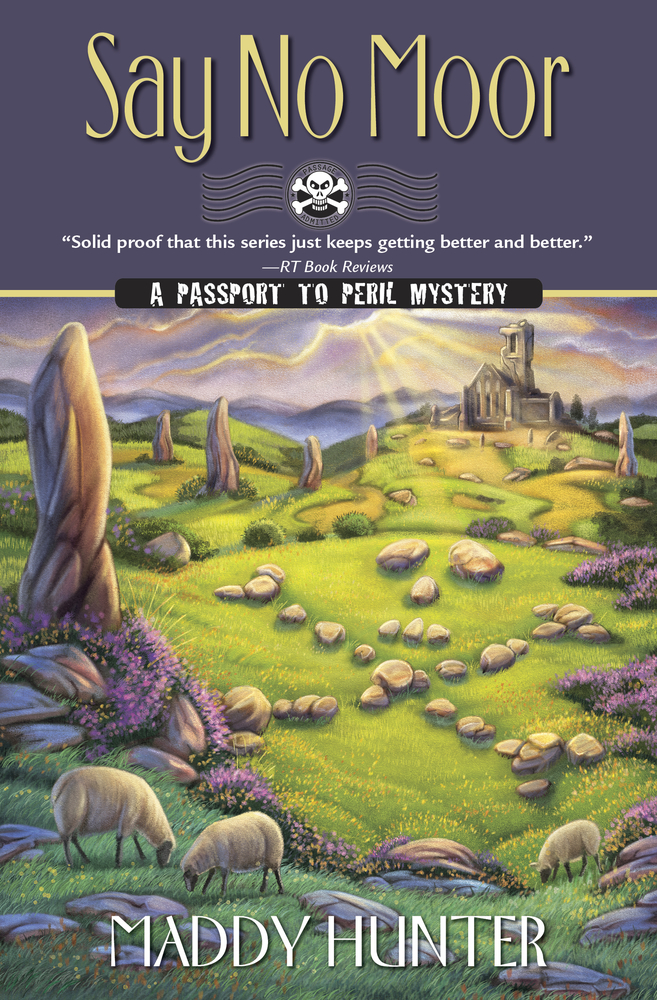
Say No Moor Tour escort Emily Andrew-Miceli's plan to boost her business with social media threatens to backfire in merry old England

Hoping to reach an expanded clientele of senior travelers, Emily Andrew-Miceli invites a handful of bloggers to join her group's tour of England's Cornwall region. But when the quarrelsome host of a historic inn dies under suspicious circumstances, Emily worries that the bloggers' online reviews will torpedo her travel agency.

To make matters worse, Emily is roped into running the inn, and not even a team effort from her friends can prevent impending disaster. As one guest goes missing and another turns up dead, Emily discovers that well-kept secrets can provide more than enough motive for murder.

Praise for the Passport to Peril Mystery Series:

"A bit of humor, a bit of travel information and a bit of mystery add up to some pleasant light reading."—Kirkus Reviews

"The cast of characters is highly entertaining and the murder mystery mixed with good humor!"—Suspense Magazine

"Maddy Hunter's Passport to Peril series is a first-class ticket to entertainment."—Carrie Bebris, award-winning author of the Mr. & Mrs. Darcy Mystery series


Maddy Hunter has endured disastrous vacations on three continents in the past five years. The first six titles in the Passport to Peril Mystery series are available from Pocket Books; books seven through eleven are available through Midnight Ink Books. The first in the series, Alpine for You, was an Agatha Award finalist and a Daphne du Maurier Award finalist. Also, Hula Done It?, Pasta Imperfect, and Top O' the Mournin' were named to the Independent Mystery Bookseller's Association bestseller list. The author resides in Madison, Wisconsin. For more information, go to MaddyHunter.com.

Wednesday, July 29, 2015

For the Love of Crime Fiction


 by: Nina Milton
 
When I tell people I write crime fiction, the one thing I’m not hoping to hear is, “Oh, I neverread crime fiction.”

Not because I want them to buy my books, but because I simply don’t believe them. Of course they read crime fiction. They just don’t know it. No way would I admit what I’m actually thinking, which is, “that’s a whole heap of baloney, pal – the literary equivalent of the excrement of the male cow.”

I belong to a local reading club, ten or fifteen of us discussing the books we’ve loved, and sometimes I get that sort of response when introduced to a new member. “A crime fiction series? That won’t interest me, I never read it.” The second part of their little speech hangs in the air, unsaid but perfectly clear– “Crime fiction is way below my reading standard.”

Even when I overhear whisperings in the reading club shadows, “ah, Nina Milton, she’s a novelist with a big US publisher, you know…but it’s onlycrime fiction…” I don’t bite. I don’t want to be accused of being a “precious author” who can’t take a critique of their work, I just wait, like a cheetah, poised at the edge of the Savannah eyeing up the wildebeests, for the moment they start talking about books…“I love the work of Charles Dickens…” Or, “I’m very into William Faulkner.”


Then I point out, the smile plastered over my face, that Charles Dicken’s Oliver Twist was a story of street kids abused and corrupted by gangs of professional criminals.


Bleak House was a legal thriller that Grisham would have probably been proud to write and The Mystery of Edwin Brood…well, it’s in the title, you fool. As for Nobel Laureate Faulkner, not only did he work on the screenplay of The Big Sleep, but wrote a thriller called Sanctuary.


Edgar Allen Poe
Then there’s Dicken’s friend Wilkie Collins, who’s every novel was a mystery thriller, plus Patricia Highsmith, Edgar Allan Poe and Graham Greene, all writers now studied at college. 

Donna Tartt produces something criminal every ten years or so, to delight serious readers and crime fans alike, recently winning acclaim across the world for The Goldfinch, the story of a stolen painting. And, as if to prove my point, Scottish novelist Kate Atkinson recently won literary prizes for her surprising and memorable book,Life After Life, straight after publishing  her “Jackson Brodie” series about a DI turned private eye. These have already been adapted for British TV as Case Histories, and Shonda Rhimesis developing a pilot called The Catchfor the US market.

And did you know that Mark Twain’s Huck and Tom solved a murder and collected $2000 in Tom Sawyer, Detective? Twain was also the first writer to use fingerprints in his short story, The Thumbprint and What Became of It.

We haven’t even got started on the many crime novels which have been showered with accolades from the literary giitterati; writers like Dashiell Hammett, Elmor Leonard, Raymond Chandler,  Steig Larsson, Peter Hoeg, Georges Simenon. And of course, P D James, who, in her latter years, also wrote a mystery sequel to Pride and Prejudice, Death Comes to Pemberley.

In fact, it is difficult to write a book, even one that is likely to reach literary heights, without there being an element of mystery within it, without it being thrilling, and without, underneath all of this, some sort of dark secret. I believe it’s the crime writer who best reflects their society, and all shades.

In any case, it’s hard to define exactly what makes a book “good literature”, but I think most people would go with the books which raise questions for the reader, especially about the validity of society’s morals, which is written with style, so that every sentences gets you thinking, and yet is beautiful in its own right.

I don’t pretend to be a literary writer, but I do attempt, right from the start of plotting each of my “Shaman Mystery” novels, to explore the themes I’ve chosen with some depth, and within that, to examine what it is to be human. I do that by choosing crimes that are deeply evil in some way, and observing how people cope, react. In the Moors examines the appalling crime of pedophilia. Unraveled Visionslooks at how desperate people seek a better life in a new country to only become exploited. Beneath the Tor,due for release in December 2015, will investigate the “legal hi” problems and mental health issues. Because my heroine is a shamanic therapist with a big heart, I always feature the victims and their families in my books, as well as the law enforcers and the criminals. These are the people Sabbie Dare is interested in helping.

I think P. D. James put it well; A detective story can give a much truer picture of the society in which it’s written than a more prestigious literature…crime fiction confirms our belief, despite some evidence to the contrary, that we live in a rational comprehensible and moral universe.


                                                            Ends.


The 1st Shaman Mystery, IN THE MOORS -“Sabbie Dare is the most compelling protagonist I’ve met this year...Milton’s tale is riveting.”—Library Journal (starred review)


The 2nd Shaman Mystery, UNRAVELED VISIONS
“[A] thrilling tale.” —RT Book Reviews


"The depictions of shamanic journeying are vivid and authentic. Reading BENEATH THE TOR kept me up at night much later than I wanted, because I could not bear to miss the next bit."—RONALD HUTTON, AUTHOR OF THE TRIUMPH OF THE MOON, SHAMANS, AND PAGAN BRITAIN


Nina Milton (Wales) has been publishing short stories and children’s books for thirty years. She’s won many literary competitions, including the Crossroads Competitions, Kent Festival Prize, and the Wells Literary Shirt Story Competitions. She enjoys exploring the magical landscapes of Britain with her husband, James. Visit her blog at http://KitchenTableWriters.Blogspot.com


Saturday, April 11, 2015

MARCH & APRIL RELEASES!


Check out these fantastic new releases!


“A great mystery and a romp into the fantasy world 
that is dark, frightening, and a whole lot of fun.”
SUSPENSE MAGAZINE


“Crackerjack entertainment: taut, gritty 
and full of devilish twists.”—KIRKUS REVIEWS


"A compelling mystery full of near-misses
 and scientific wisecracks."—LIBRARY JOURNAL


Wednesday, February 11, 2015

FEBRUARY RELEASES!


By: Maegan Beaumont


Take a look at the fantastic Midnight Ink has to offer this month!


 Death & the Redheaded Woman
By: Loretta Ross 
An Auction Block Mystery #1

Starred Review“Ross’ thoroughly entertaining debut combines smart details about the auction business with two engaging mysteries and a uniformly appealing cast. Fans of small-town cozies, especially those by Denise Swanson, will love this, as will mystery readers who double as thrift-store aficionados and followers of auction reality shows.”—BOOKLIST (STARRED REVIEW)

Drawing Conclusions
By: Deirdre Verne 
A Sketch in Crime Mystery #1

"Verne's mystery is a winner, with plenty of twists and turns, an intriguing heroine and an ending that shocks in more ways than one."—KIRKUS REVIEWS


Starred Review“Lourey skillfully mixes humor and suspense . . . the characters are wonderful and wacky, and the mile-a-minute pace never falters.”
BOOKLIST (STARRED REVIEW)

Friday, January 9, 2015

January Releases!


By: Maegan Beaumont


It's a new year and Midnight Ink is kicking it off with some FANTASTIC new releases!


A Killer Retreat
By: Tracy Weber 

A Downward Dog Mystery #2 

Cozy readers will enjoy the twist-filled plot.”—PUBLISHERS WEEKLY

Dying for the Past
By: TJ O'Connor 
A Gumshoe Ghost Mystery #2


"The twisty plot is well delivered . . . Anyone who loves a strong ghost yarn will savor this tale."—LIBRARY JOURNAL


The Accidental Alchemist
By: Gigi Pandian 
An Accidental Alchemist Mystery #1


“This reviewer is eagerly anticipating more from this series, and a return of a cast more fun than an episode of Portlandia.”—RT BOOK REVIEWS 1/2


Tuesday, January 6, 2015

Dying For the Past – The Roots of This Sequel – Part II

By Tj O’Connor, author of Dying to Know, Dying for the Past, and Dying to Tell 

It’s here. Hold the presses. Ready the fireworks. Make ready the launch … Dying for the Past hits the shelves tomorrow!Detective Oliver Tuck” Tucker is back in Book II of his Gumshoe Ghostseries, and he’s ready to solve another case. This one, as explained in Part I of this two-part blog “Dying for the Past—The Roots of this Sequel” centers around the murder of a wealthy and mysterious philanthropist with connections to a 1930s mobster’s journal containing the secrets of Washington D.C.’s powerbrokers, gangsters, and spies.    

Everyone wants the book. And they’ll do anything—especially kill—to get it.
In Part I of this blog, I explained that Tuck is up against Vincent Calaprese, the spirit of a 1930’s gangster, the Russian Mob, and several conniving suspects. Someone killed Stephanos Grecco—a wealthy philanthropist—in front of a hundred charity gala guests dancing the night away. The story surrounds the search for Vincent’s journal—the book—in which he kept tabs on spy rings, mob bosses, and corrupt Washington D.C. elite. Vincent used his journal to persuade the FBI from shutting down his operations and keep his mob competition at arm’s length. Over the years, the book became a shield against the growing Russian mob and corrupt government officials. To mess with Vincent’s family meant risking the book telling its stories.
This subplot is based on true events.  
During the run-up to WWII, some mob leaders helped our government thwart, and in some cases, directly combat our enemies. Known mob kingpins are believed to have kept track of Axis spies operating in the country and reporting activities to the authorities, in particular, with ports and rail yards where sabotage was a threat. During those years (and perhaps still today), the mob had special access to ports, rail, and coastal cities —they had their own networks controlling the docks and cargo throughout the country; they also had enormous power over the labor unions working those areas. I suppose that while they were mobsters and racketeers, they were still Americans and, in a world war where nationalism was the battle cry, even the bad guys waved the flag.
One story has it that Meyer Lansky, along with a key mob boss and pal, Salvatore C. Luciano, a.k.a. Lucky Luciano, played key roles in keeping union dockworkers from striking during the war and aiding in the successful invasion of Sicily by American forces. Further, Lansky helped our government recruit fellow mobsters, Bugsey Siegel and Lepke Buchalter. The three gangsters were reportedly merciless at intimidating potential German-American Nazi sympathizers to keep them from gaining any foothold in the country. These men also played other roles while working for the government. Lucky Luciano also reportedly played a vital role in aiding the U.S. invasion of Sicily. Luciano was a notorious Italian boss with power in both the U.S. and in Sicily. According to historical accounts, Luciano traded his freedom from prison for his assistance in helping secure intelligence and cooperation from Sicilian mob assets.
There’s a long list of other mob aficionados who aided our government in fighting the Axis powers here and abroad. Few of them our government owned up to after the war. One story even suggests Luciano parachuted into Sicily behind enemy lines to make contact with mobsters—a significant power in Sicily—and organize them to aid the Allied invasion.
With history like this, how could I resist? So, while creating Vincent Calaprese and his delectable girlfriend, Sassy, I penned Vincent as a hot-cold, good-mobster, bad-mobster kinda guy. His connection to pre-WWII espionage and corruption is the backstory of Dying for the Past—and what better vehicle to connect the past with the present than a dangerous journal that named names and could blaze a trail to modern day espionage and corruption in 2015? And of course, the book and its stories were worth killing for.
The next ingredient in my story is Tuck’s family background and what secrets his unknown past might reveal. For those of you who have read Dying to Know, you know that Tuck was an orphan raised in foster care. He never knew anyone or anything about his family. In Dying to Know, we learn that Doc, his cantankerous spirit guide, is family. In Dying for the Past, we’ll begin to learn that being a ghost is hereditary and Tuck’s roots may well include mobsters, spies, cops and robbers, and a host of wayward spirits—pun intended. Ultimately, as Tuck’s stories continue, all the books will be connected through Tuck’s family past. There is a method to my madness and an intricate web of spirited lineage that will tie the cases—and the characters—all together. It suffices to say that Tuck’s murder was not an accident—and neither was Doc’s or the rest of Tuck’s family. In fact, they were all dying to get together. Wow, is that another book title?
Why am I so connected to the past myself? I have no choice—my own family tree has some interesting stories, too.
As a young boy, my grandfather, Oscar, told a few tales of his life in the 30s and 40s. As a very young man, he took to life as a hobo and rode the rails around the east coast looking for adventure—and work—during the Great Depression. In WWII, he was one of the oldest draftees and his exploits included working for a Military Intelligence Officer in the Pacific Theatre. My great uncle, John, was a drummer for the likes of the Dorsey Brothers, Gene Kruppa, and Glenn Miller. While I don’t think anyone ever heard of him, my grandparents were his biggest fans and instilled a love of Big Band and Swing music in me. In Dying for the Past, that music plays a unique role in Vincent Calaprese’s chapters and help me keep his era alive throughout the story. And last, but perhaps most significant is my mentor for the past 24 years, Wally, who is one of the last remaining OSS operatives (Office of Strategic Service—the forerunner to the CIA) still alive today. After the war, Wally joined the CIA and became one of its senior executives through the cold war and into the 80s. He fought the Germans in Northern Africa and Europe, fought the communists in Greece, the Russians throughout the world, and all enemies in between (and I dare say a bunch of Washington bureaucrats, too) until his retirement. His exploits and his life story are a constant source of material for my books. It is no secret that Wally is thinly disguised as Doc—Tuck’s omnipotent, brassy spirit mentor—in all of Tuck’s stories.
As you can see, history is a big part of my life and is a constant theme throughout my books. In my upcoming Dying to Tell, Book III in Tuck’s series, the OSS and a WWII operation in the Middle East play a significant role in a series of murders. Dying to Tell releases in January 2016.
For you history and mystery aficionados, I hope you’ll give Dying for the Past and Dying to Know a read. When you do, drop me a line at tj@tjoconnor.com and let me know what you think.
For the New Year, stay safe and well!


TJ O’CONNOR IS THE AUTHOR OF DYING FOR THE PAST and DYING TO KNOW, available in books stores and e-books from Midnight Ink. His third paranormal mystery, DYING TO TELL, will be released January 2016. Tj is an international security consultant specializing in anti-terrorism, investigations, and threat analysis—life experiences that drive his novels. With his former life as a government agent and years as a consultant, he has lived and worked around the world in places like Greece, Turkey, Italy, Germany, the United Kingdom, and throughout the Americas—among others. He was raised in New York's Hudson Valley and lives with his wife and lab companions in Virginia where they raised five children. Dying for the Past and Dying To Know are the first of eight novels to be published.  Learn more about Tj’s world at www.tjoconnor.com and on Facebook at https://www.facebook.com/TjOConnor.Author


Tuesday, December 2, 2014

Dying for the Past - The Roots of the Sequel Part I

  By Tj O’Connor, author of Dying to Know & Dying for the Past

Countdown—39 days to the launch of Dying for the Past, my first sequel to Oliver “Tuck” Tucker’s debut in Dying to Know. Tuck is back in Book 2 and he’s on a new case with the help of his beautiful and brilliant professor-wife, Angel, and Detective Bear Braddock, his always faithful, always-protective ex-partner. Or maybe I’m describing Hercule, his black Lab companion. Both I think.

Tuck has just started settling down into his new life as a dead detective after wrapping up his own murder and ending the killing spree of a serial killer. Things have been going well for him—all things being considered that is.  

Tuck finds that being dead is often bittersweet. He explains a little in Chapter 1 of Dying for the Past

Sometimes, being dead is not so bad. Like poofing in and out of places on a whim without bothering with doors and stairs. And you never have to pee or get the flu again—big pluses. Then there are times, though, when dead is depressing and sad. It’s the things you miss—the taste of good wine, the adrenaline-rush of chasing a suspect, or the feeling when you’re in the middle of the dance floor with the most beautiful woman in the room. Those moments hurt.

A woman with shoulder-length auburn hair and sparkling green eyes stood in the middle of the mansion’s ballroom. Her long, silky gown was icing poured hot over sultry curves. All eyes fixed on her when she embraced a tall, distinguished-looking older man before a dance. He wore a tux—okay, yeah, he was striking with gray hair and a strong, muscular build, brilliant, rich, blah, blah, blah. Big deal. The two could have been on a wedding cake, but instead were the center of attention at Angel’s big band-themed charity gala, and leading a turn around the floor to Glenn Miller’s Moonlight Serenade.

When they took their first step, I turned away …

Then wham. Someone’s dead. Not just any someone, mind you, but a shifty rich guy with a carnation on his lapel and a beautiful, but angry young bride on his arm. The only things anyone knows about this mysterious philanthropist is that he has too much money, too beautiful a young wife, and one-too-many bullet holes in him.

Mr. Carnation hailed a passing waiter for a refill of champagne. After downing the glass in a single gulp, he lifted Angel’s hand for a melodramatic kiss.

His glass shattered and spasms jerked his body all the way to the floor. His right arm thrust out and pointed at the crowd; his left still held the broken glass stem. His body twitched a few more times and stilled …

… I’d seen death before—and murder, too often. Not just my own, but dozens.

This one was unmistakable. It wasn’t the way Mr. Carnation collapsed in a jerky, melodramatic spiral to the hardwood. It also wasn’t the way his dull, lifeless face caught the dance ball light either. It was much simpler.

      It was the blood pooling around his body and the bullet hole through his torso.

Someone murdered Mr. Carnation—shot him in front of two hundred witnesses. A killer jitterbugged in and gunned him down to Benny Goodman.”

In Dying for the Past, Tuck realizes pretty quickly that it’s all about just that—the past. For Tuck, his past started to haunt him (pardon the pun) after his murder. You see, being dead also comes with some perks—spirited perks, like touching crime scene objects that show him a few snippets of their meaning (though often veiled) and being able to move about without the delays of traffic or bad weather. He can pop in and out of places at a whim. He just has to know where he wants to be. No, he has no after-life intuition or clairvoyance—it always comes down to plain old detective work. Now, he has to figure out how to use his new-found talents and a couple unusual characters to solve the case.
 
“Across the room, standing alongside the dance floor, was an uninvited guest. He was a stout, striking man in a black pinstripe, double-breasted suit. He wore shiny, buffed wingtips and a gray felt fedora. The only thing missing was a big cigar hanging out of his mouth and a violin case. Then, he swept his hand across his jacket and revealed a heavy semi-automatic in a shoulder holster. Did someone invite Al Capone?

He looked at me and winked. Winked …

… Voices hushed as eyes fell on the dead man.

Not me, though, I watched the crowd, looking for the killer and any telltale sign of the smoking gun.

But what I saw, or didn’t see, unnerved me more.

The gangster in the black pinstripes was gone … vanished—poof. He arrived just in time for a killing and left before the body hit the floor. No sign of his spats and black tie remained. He didn’t leave his fedora or heater behind either. He was as dead and gone as Mr. Carnation.

The question was, however, would he stay that way?”

In Dying for the Past, Tuck begins to learn some of his own family secrets. First, after witnessing the murder of Stephanous Grecco in front of his wife and a hundred people at the Vincent House—no one saw anything—Tuck finds himself searching for the killer and wondering what it all has to do with his own family tree. What does he find along the way?
      ·       Vincent Calaprese—the spirit of a 1939 mobster boss with his hooks into Tuck’s family tree.
      ·       Sassy—the eye-candy delight always on Vincent’s arm and always after Tuck’s eye.
      ·       Doc Gilley’s secret just within arm’s reach. Can Tuck get the truth out of him?
      ·       Someone stalking Angel, but what does it have to do with Steve and Bonnie Grecco—the new rich elite in Winchester? And what does AndrĂ© Cartier, Angel’s only family and mentor, have to do with all of it?
      ·       Why are the FBI, US Attorney’s Office, and a television ghost-hunter all converging on the Vincent House?
      ·       Also, why is Poor Nic Bartalotta—retired New York mob boss extraordinaire—connected to the Russian Mob and missing federal snitches?
      ·       Above all, who will find The Book—Old Vincent’s gangster journal holding the secrets to a bundle in loot and the names and evidence on the who’s who of Washington D.C.’s World War II spies, mobsters, and corrupt-elite. You’d be surprised how many are still around these days.

The answers come from the past and the victims are Dying for the Past.

Stay tuned to this channel—same InkSpot Time, same InkSpot channel. Next month, I’ll disclose some of the past behind Dying for the Past. Like …
      ·       What’s the backstory to Vincent Calaprese and his pre-World War II escapades?
      ·       What’s the story behind Tuck, Doc, and his wayward ancestors?
      ·       Why am I so connected to the past myself? What skeletons and secrets do I have hidden deep away?

If you can guess any of these answers, drop me a line here or email me at tj@tjoconnor.com

Be looking for Dying for the Past out on your bookshelves January 8, 2015!

Tj O’Connor lives in Virginia with his wife and three Labs. Dying to Know is the fourth of his eight novels and is currently available in bookstores and online. Dying for the Past, the first of two sequels, will be released in January 2015—available now for pre-orders. Tj is an international security consultant specializing in anti-terrorism and investigations. Learn about his world at www.tjoconnor.com and Facebook at www.facebook.com/TjOConnor.Author.